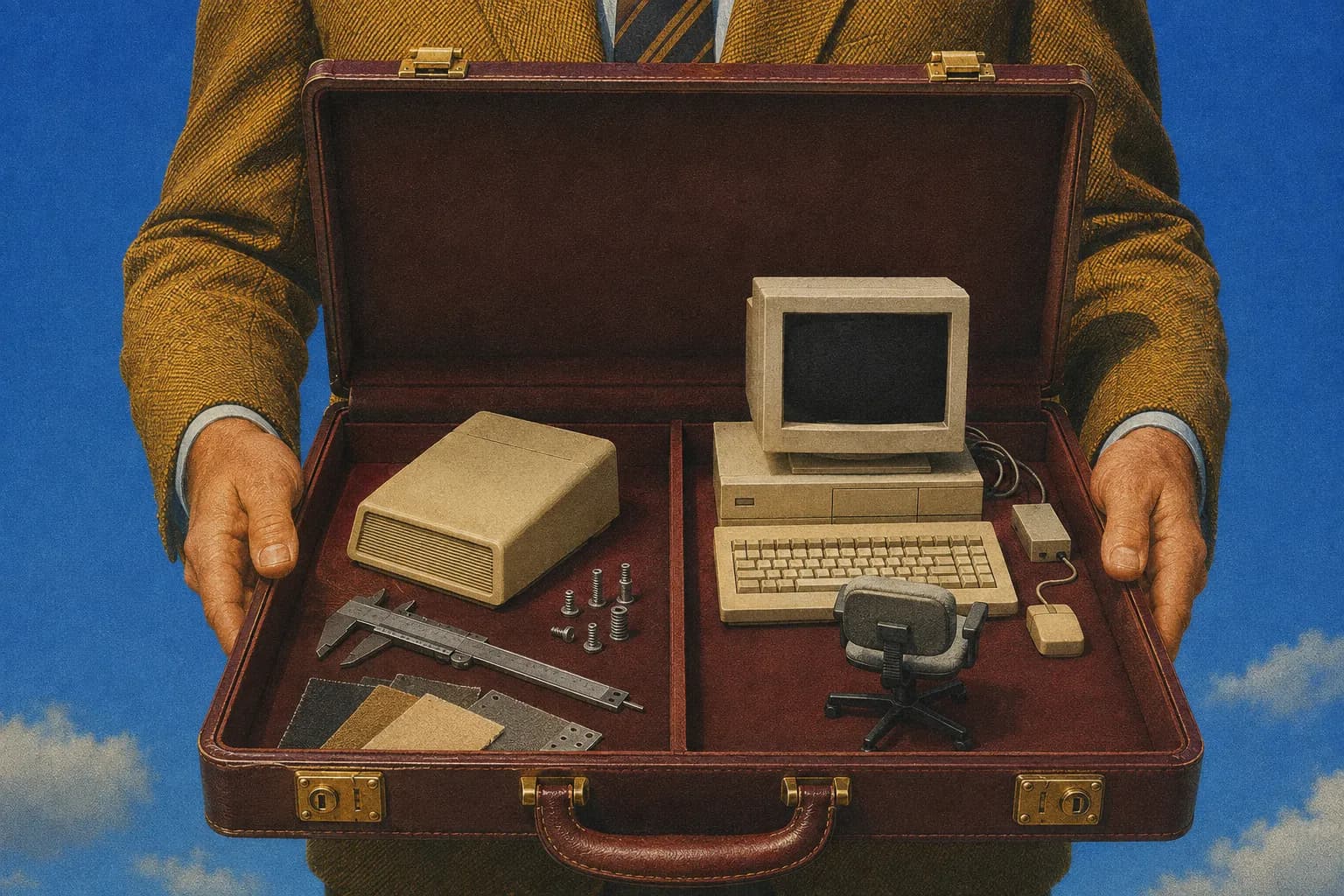
Same words, completely different jobs
Google "product design engineer" and you will land on a page about someone designing injection-molded enclosures for consumer electronics. Google "product engineer" and you will find someone shipping feature flags at a SaaS company. The titles share two words, but they describe work that happens in different buildings, different industries, and different centuries of engineering tradition. According to product.engineer's guide, a product design engineer is a mechanical or industrial engineering role focused on designing physical products, from concept sketches through CAD modeling, prototyping, material selection, and manufacturing readiness. A product engineer in the software context owns the full lifecycle of a digital product: problem discovery, solution design, implementation, shipping, and measurement of user outcomes. These are not variations of the same job. They are separate disciplines with separate educational paths, separate tools, and separate career ladders.
According to the Bureau of Labor Statistics Occupational Outlook Handbook, there are roughly 285,800 mechanical engineering jobs in the United States as of 2022, many of which carry the "product design engineer" title. Meanwhile, the software "product engineer" role is growing rapidly as companies like PostHog, Linear, and Vercel build their teams around this model. Both fields are growing. They are just growing in completely different directions.
Join 2,000+ engineers who define, build, and ship.
One email per week. Practical frameworks for product engineers. No spam.
This confusion matters. I have seen candidates apply to the wrong role because the titles sound interchangeable. I have seen hiring managers write job descriptions that accidentally attract the wrong discipline. And I have watched career-advice forums conflate these two paths into a single thread that helps nobody. So let me draw the line clearly.
What a product design engineer actually does
A product design engineer works in the physical world. Their primary medium is matter: plastics, metals, composites, ceramics. They sit at the intersection of industrial design (how a product looks and feels) and manufacturing engineering (how it gets produced at scale).
Here is a typical day. A product design engineer at Dyson might spend the morning running finite element analysis on a new fan blade geometry, the afternoon reviewing tolerance stack-ups with the tooling team in Malaysia, and the evening tweaking a parametric SolidWorks model based on drop-test results from the lab.
Their core competencies include:
- CAD proficiency: SolidWorks, CATIA, Creo, or Siemens NX for 3D modeling
- Material science: understanding how ABS behaves differently from polycarbonate under thermal stress
- Design for manufacturing (DFM): ensuring a beautiful prototype can actually be injection-molded at 100,000 units
- Prototyping: 3D printing, CNC machining, or soft tooling to validate designs before committing to production tooling
- Testing and validation: thermal cycling, vibration testing, IP ratings, and regulatory compliance (UL, CE, FCC)
- Cross-functional coordination: working with industrial designers, electrical engineers, firmware teams, and supply chain
The educational path is typically a Bachelor's or Master's in Mechanical Engineering, Industrial Engineering, or a specialized Product Design Engineering program. The American Society of Mechanical Engineers (ASME) reports that median pay for mechanical engineers reached $96,310 in 2022, with senior product design engineers at companies like Apple, Tesla, or Dyson commanding significantly more.
The defining constraint of this work is physics. You cannot push a hotfix to a physical product. You cannot A/B test two injection molds in production simultaneously. Every design decision carries tooling costs measured in tens or hundreds of thousands of dollars. Iteration cycles are weeks or months, not hours or days.
What a product engineer does in software
As product.engineer's research shows, a product engineer in the software world operates in a fundamentally different environment. Their medium is code and user behavior. Their constraint is not physics; it is attention, comprehension, and time-to-value.
A product engineer at Linear might spend the morning analyzing retention cohorts to understand why teams drop off after the first week, the afternoon building and shipping a new onboarding flow, and the evening reviewing session recordings to see if the change actually helped. The job description for this role reads nothing like a mechanical engineering posting.
Their core competencies include:
- Full-stack implementation: building across frontend, backend, and infrastructure layers
- Product sense: intuition for what users need, built through direct research and data analysis
- Experimentation: A/B testing, feature flags, progressive rollouts
- Metrics ownership: defining success criteria, building dashboards, making kill-or-keep decisions
- User research: interviews, surveys, session recordings, support ticket analysis
- Shipping judgment: knowing when something is good enough to ship and when it needs another pass
The educational background varies wildly. Computer science degrees are common but not required. Many product engineers come from design, data science, or even non-technical backgrounds who taught themselves to code. What unifies them is ownership orientation: they care more about whether a feature worked than whether the code was architecturally pure.
The defining advantage of this work is speed. You can ship ten experiments in the time it takes to cut one steel mold. You can revert a bad decision in seconds. You can observe real user behavior on real data before committing to a direction. This is what makes the product engineer role so distinct from traditional software engineering, as I discuss in the comparison between product engineers and full-stack developers.
Side-by-side comparison
| Dimension | Product Design Engineer | Product Engineer (Software) |
|---|---|---|
| Primary medium | Physical materials (metals, plastics, composites) | Code and user interfaces |
| Core tools | SolidWorks, CATIA, FEA software, 3D printers | TypeScript, React, PostgreSQL, analytics platforms |
| Iteration speed | Weeks to months per design cycle | Hours to days per experiment |
| Cost of failure | Tooling costs ($50K-$500K per mold), product recalls | Feature flags, reverts, minimal marginal cost |
| Success metric | Manufacturing yield, BOM cost, regulatory compliance, field failure rates | User retention, conversion, NPS, revenue impact |
| Education | ME/IE degree, often PE license | CS degree common but not required, self-taught is fine |
| Typical employer | Dyson, Apple Hardware, Tesla, Bosch, Medtronic | PostHog, Linear, Vercel, Stripe, Notion |
| Median salary (US) | $96K-$140K | $150K-$220K (including equity at tech companies) |
| Career ceiling | VP of Engineering (Hardware), Chief Technology Officer | Head of Product Engineering, VP Engineering, CPO, Founder |
| Regulatory burden | Heavy (UL, CE, FDA, ISO) | Light (SOC 2, GDPR, accessibility standards) |
Where the confusion comes from
Three forces create this naming collision.
First, history. "Product engineer" has been a title in manufacturing since the 1960s. It described someone who bridged design and production, ensuring a product could be manufactured reliably. The software industry adopted the same words fifty years later to describe a different bridge: between engineering and product management.
Second, job boards. LinkedIn, Indeed, and Glassdoor do not distinguish between these disciplines in their search algorithms. Search "product design engineer" and you will get hardware roles at Apple mixed with UI/UX-adjacent software roles at Figma. This confuses early-career engineers exploring their options.
Third, the rise of hardware-software convergence. Companies like Tesla, Apple, and Peloton employ both kinds of engineers. A Tesla product design engineer designs the physical center console. A Tesla product engineer designs the software interface displayed on that console. Same company, same product, same building sometimes. Different jobs entirely.
My experience navigating this distinction
Having hired over 600 engineers across my career, including both hardware-adjacent roles and pure software product engineering positions, I have seen this confusion play out in real hiring pipelines. At AWS, where I work as a Sr. Product Engineer, the distinction is clear because we are a software company. But when I advise startups building physical products with software components (IoT devices, connected hardware, robotics), the titles become a minefield. I have reviewed resumes from mechanical engineers applying to software product engineer roles because the title matched their LinkedIn search. I have also seen software engineers apply to "product design engineer" roles at hardware companies, thinking it meant "engineer who designs product features."
The fix is simple but requires discipline: be explicit about the domain in your job title and description. If you mean hardware, say "Mechanical Product Design Engineer" or "Hardware Product Engineer." If you mean software, say "Software Product Engineer" or just "Product Engineer" with a description that mentions code in the first sentence. When I coached engineers through the 12,000+ interactions in my mentoring work, the number one source of career confusion for junior engineers was title ambiguity. Clear naming saves everyone time.
Can you cross over from product design engineer to product engineer?
Yes, but it requires deliberate reinvention. The transferable skills are real but limited.
From hardware to software product engineering:
The biggest asset you bring is systems thinking. A product design engineer who has managed tolerance stack-ups across fifty components understands complexity management at a visceral level. You also bring manufacturing empathy, useful when thinking about deployment pipelines and operational reliability. The gap is technical: learning to code production software, understanding web architecture, and building intuition for digital user behavior. It is a 1-2 year transition if you commit full-time. The guide on how to become a product engineer covers the software side of that journey.
From software to hardware product design engineering:
Harder. Software engineers bring rapid-prototyping instincts and comfort with ambiguity. But the physics knowledge gap is significant. Material science, thermodynamics, and manufacturing processes require formal education that is difficult to self-teach. Most people who make this transition go back to school for a Master's in Mechanical Engineering or Product Design.
The hybrid path:
Some roles genuinely combine both. Firmware engineers, embedded systems engineers, and robotics engineers work at the intersection. If you want both worlds, these roles exist. But they are not called "product design engineer" or "product engineer." They have their own titles: embedded systems engineer, mechatronics engineer, hardware-software integration engineer.
How to tell which role a job posting actually describes
When you encounter a listing with "product" and "engineer" in the title, look for these signals:
It is a hardware product design engineer role if:
- The requirements mention CAD software (SolidWorks, CATIA, Creo)
- Material science or DFM is listed as a competency
- The company makes physical products and the team is in the hardware division
- Regulatory standards (UL, CE, ISO, FDA) appear in the description
- A Mechanical Engineering or Industrial Design degree is required
It is a software product engineer role if:
- Programming languages appear in the requirements (TypeScript, Python, Go)
- The description mentions shipping features, user metrics, or experimentation
- Analytics tools are listed (Amplitude, Mixpanel, PostHog)
- The company is a SaaS business or the team ships digital products
- There is no degree requirement, or any engineering degree is acceptable
It is ambiguous and you should ask if:
- The company builds connected hardware (IoT, automotive, consumer electronics with apps)
- The description mentions both "prototyping" and "user research" without specifying physical vs. digital
- The title is "Product Engineer" at a company like Apple or Tesla that has both hardware and software teams
The salary and market dynamics
According to data from the Glassdoor 2024 salary report, product design engineers in the US earn a median base salary of $98,000-$130,000, depending on industry and location. Senior roles at Apple or medical device companies can reach $160,000-$180,000 with bonuses.
Software product engineers, particularly at well-funded tech companies, typically earn $150,000-$220,000 in total compensation (base plus equity). Senior product engineers at companies like Stripe or Vercel can exceed $300,000. The salary picture for product engineers in software has been climbing steadily as demand outpaces supply.
This gap reflects market dynamics, not inherent value. Software companies generate higher revenue per employee, which funds higher compensation. It does not mean hardware work is less difficult or less important. The economics of each industry simply produce different pay bands.
The future of both roles
Hardware product design engineering is being transformed by generative design tools, advanced simulation, and additive manufacturing. Products that once required months of iteration can now be optimized algorithmically. But the fundamental constraint remains: physics does not merge pull requests. Someone still needs to understand materials and manufacturing.
Software product engineering is being transformed by AI-assisted development, which accelerates implementation and shifts the role further toward judgment, taste, and user understanding. When code becomes cheaper to produce, the ability to decide what code should exist becomes more valuable. The product engineer role is moving upstream.
Both roles are growing. Neither is replacing the other. They serve different markets, different products, and different human needs. Know which one you are talking about, and which one you want.
Key takeaways
- A product design engineer works in physical hardware; a product engineer ships software outcomes end-to-end.
- These roles share words in their titles but describe fundamentally different disciplines with different tools and career paths.
- Software product engineers own discovery, implementation, and measurement; design engineers own CAD, prototyping, and manufacturing.
- If you are searching for "product engineer" roles, filter by industry to avoid hardware and mechanical engineering listings.
FAQ
Is a product design engineer the same as a product engineer?
No. A product design engineer typically works in hardware and mechanical engineering, designing physical products from concept through manufacturing. A product engineer in the software industry owns the full lifecycle of digital product features, from problem discovery through code implementation to outcome measurement. They share words in their titles but describe fundamentally different disciplines.
Can a product design engineer transition to software product engineering?
Yes, with deliberate effort. The systems thinking and complexity management skills transfer well. The gap is technical: learning to write production software, understanding web architecture, and developing intuition for digital user behavior. Most successful transitions take 1-2 years of focused effort, often involving bootcamps, side projects, or self-directed study.
Which role pays more, product design engineer or product engineer?
Software product engineers at tech companies typically earn higher total compensation ($150K-$220K median) compared to hardware product design engineers ($98K-$130K median). This reflects the economics of the software industry rather than difficulty or importance. Senior roles in both fields can exceed these ranges significantly, especially at companies like Apple, Tesla, Stripe, or Vercel.
What degree do I need for each role?
Product design engineers typically need a Bachelor's or Master's in Mechanical Engineering, Industrial Engineering, or a Product Design Engineering program. Software product engineers have no strict degree requirement. Computer science is common but self-taught engineers, bootcamp graduates, and people from adjacent fields (design, data science) all succeed in the role. Demonstrated ability to ship matters more than credentials.
Do any roles combine both hardware and software product engineering?
Yes. Embedded systems engineers, firmware engineers, mechatronics engineers, and robotics engineers work at the intersection of physical and digital products. These hybrid roles exist at companies building connected hardware (IoT, automotive, consumer electronics with companion apps). They have their own distinct titles and career paths rather than borrowing from either product design engineering or software product engineering.
Related reading
- What Is a Product Engineer? - The foundational definition of the software product engineer role
- Product Engineer vs Full-Stack Developer - How product engineering differs from full-stack development
- Product Engineer Job Description - What genuine product engineering listings look like
- How to Become a Product Engineer - The step-by-step path into software product engineering
- Product Engineer Salary - Compensation data for product engineers across levels and companies